It’s the most wonderful time of the year: Halloween in an election year! ‘Tis the season for a bevy of fright flicks designed to put your girlfriend in your arms and a bad taste in your mouth. Granted, high-art horror, like Antichrist, Pan’s Labyrinth, and The Passion of the Christ, usually do not enter this season’s strategic lineup, but it is good to know that today’s zombies have taken up running because, really, who wants to see a bunch of fat zombies?
This year is special because a multitude of new Americans might very well bring to fruition one-party democracy, much like 20th-century Mexico. Pundits are lauding the Hispanic-American population boom, as if it were an accomplishment akin to putting a flag on the moon or Iwo Jima. Meanwhile, a few bitter white men are expected to vote for the Republican presidential candidate because they have no pity for the new majority.
Halloween season also brings scary stories about falling SAT scores. At Breitbart.com, Ben Shapiro
lamented that “2012’s high school seniors have the worst SAT reading scores since 1972; they scored 486 on reading, out of a possible 800.” The Washington Post
reported that the scores “reached a four-decade low.” The good news and the bad news are that the elite media are reporting falsehoods, again. Shapiro can take a deep breath because his copy-and-paste error (his
Pinker error?) dropped ten points from the actual reading score. However, being too lazy to investigate the scores prior to 1972, the earliest year shown in the annual SAT report, gives the false impression that verbal scores were ever worse than now. In fact, reading scores before Woodstock stood far above the present.
A single year is unlikely to provide a momentous pivot in any of the multiple-decade trends, many of which, it seems, only my readers are aware. It is worth mentioning that the male mathematics advantage slightly grew despite the fact that the upper score limit held down an increased proportion of men relative to women.
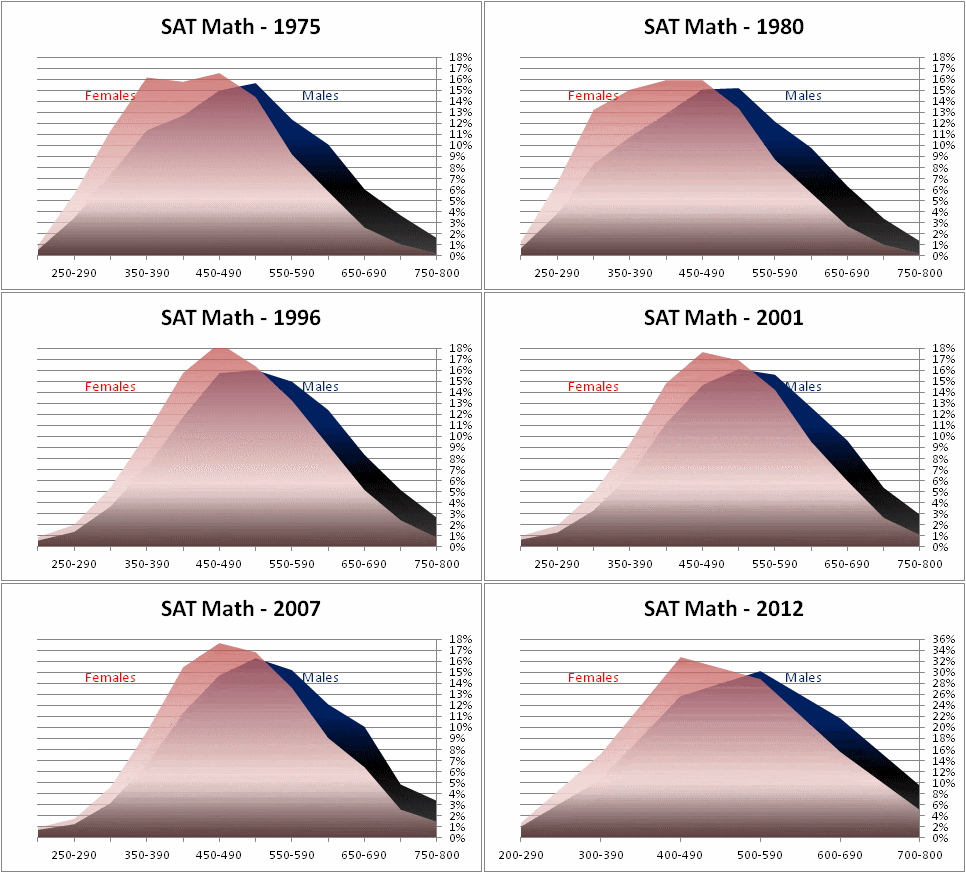
Here are some updated graphs:
SAT examinees mirror the demographic changes in America, but racial score gaps (not counting Asians) declare their constancy. With its gargantuan participation levels of highly engaged students, the SAT offers relatively noise-free output and immunity to the growing
criticism of differential motivation confounding IQ tests that lack incentives. Still, Alexander Abad-Santos, at the Atlantic’s blog,
promised that the “sweeping assumption that minority test-takers are naturally worse than their non-minority counterparts at the ‘reading’ section doesn’t tell the entire story.” He read this assumption into words that the Post apparently removed from their article that “the declining national reading averages may in part reflect the ever widening pool of students who take the SAT…. Nearly half were minorities….” Abad-Santos seems unmoved by the new numbers. Perhaps the data require a fresh style of presentation—something that fits the spirit of the season. I think back to how the Centers for Disease Control produced an
animated graph that defined the obesity epidemic as we know it. America has diversified but not with uniformity. Maybe this calls for a map that illustrates the score changes like an infectious outbreak—or a zombie apocalypse!
Forget the numbers. This night of the testing dread is in full color. White (and light pink) represent superior scores. Red is mid-range. Yellow and the more yellow shades of orange mark the worst states (and Washington, DC, the gold star).



Now, compare those results with this map of the percentage of white and Asian SAT takers out of those who identified their race.


State SAT scores do reflect demographic change, but also test participation. Maine is among the whitest states, but its SAT scores fell when it greatly increased the proportion of students who take the test. Delaware did the same. I have expressed some doubts about the effects on scores of participation rates for various groups, but racial and gender groups cannot achieve total participation in a test, like states can. That phenomenon pushes students to take part regardless of their ability or desire to attend college. Midwestern states seem to fare best, but those states emphasize the ACT rather than the SAT. In a state like Illinois, which currently has 100% ACT participation and 5% SAT participation among high-school graduates, a student who takes both tests probably outperforms most of his or her classmates. That student may want to take the SAT to apply to a more prestigious university outside the region.
According to the Washington Post, “questions about whether the SAT is biased in favor of middle-class and wealthy students have led many colleges and universities to use other gauges or to accept an alternative exam, the ACT, which edged out the SAT in 2012 for the first time…” With regard to racial groups, ACT scores act just like those of the SAT.
The ACT even had the same surge of people who would not respond to the racial identity question, except ACT non-responders peaked in 2007 instead of 2003.
Over the years, African Americans, Hispanic Americans, and Native Americans have fallen further behind whites on the ACT.
The map of ACT scores does show a developing North-South divide somewhat like the demographic map. However, it mostly looks red because the District of Columbia used to be such an outlier. Likewise, certain New England states with low ACT participation served as outliers at the other end.

To better account for state test preferences, I created a composite SAT-ACT map. I designed a crude linear formula based on a conversion table to convert ACT scores to SAT equivalents. Then I weighted each of the two tests according to the relative participation for each state. In accordance with the conversion table, I did not consider writing scores.

Even though I kept the same color scheme as the other SAT maps, the white and pink disappeared because the map reduces the influence of overachievers who take both tests when their state has a clear preference. A worsening North-South divide clearly presents itself.
I consider this the best and most reliable map, but participation issues limit even it. I controlled for the relative participation between the tests, but not for the overall participation rates. The states that moved to total or near total participation on one of the tests were Colorado, Delaware, Illinois, Kentucky, Louisiana, Maine, Michigan, Mississippi, North Dakota, Tennessee, Utah, and Wyoming. Only Delaware and Maine have chosen to go with the SAT. By contrast, Arizona sticks out for its extremely low participation on
both tests. Clearly, Arizona has an unfair score advantage, and Iowa and California also do not have especially high testing rates, either. I decided to program a map that punishes the scores of states in which the combined participation percentages of both tests is less than 100% by a factor proportional to its deficit below 100%. The punishment is somewhat arbitrary and probably quite excessive, but at least it shows that the American Southwest has inflated scores. I consider this neither to be a “score” map nor truly “controlled,” so I reset the color ranges.

For clarity, here is a map just of the addition of the participation percentages for both tests without regard to scores. States like Florida are seeing high rates of participation on both tests because they have not settled upon a single standard.
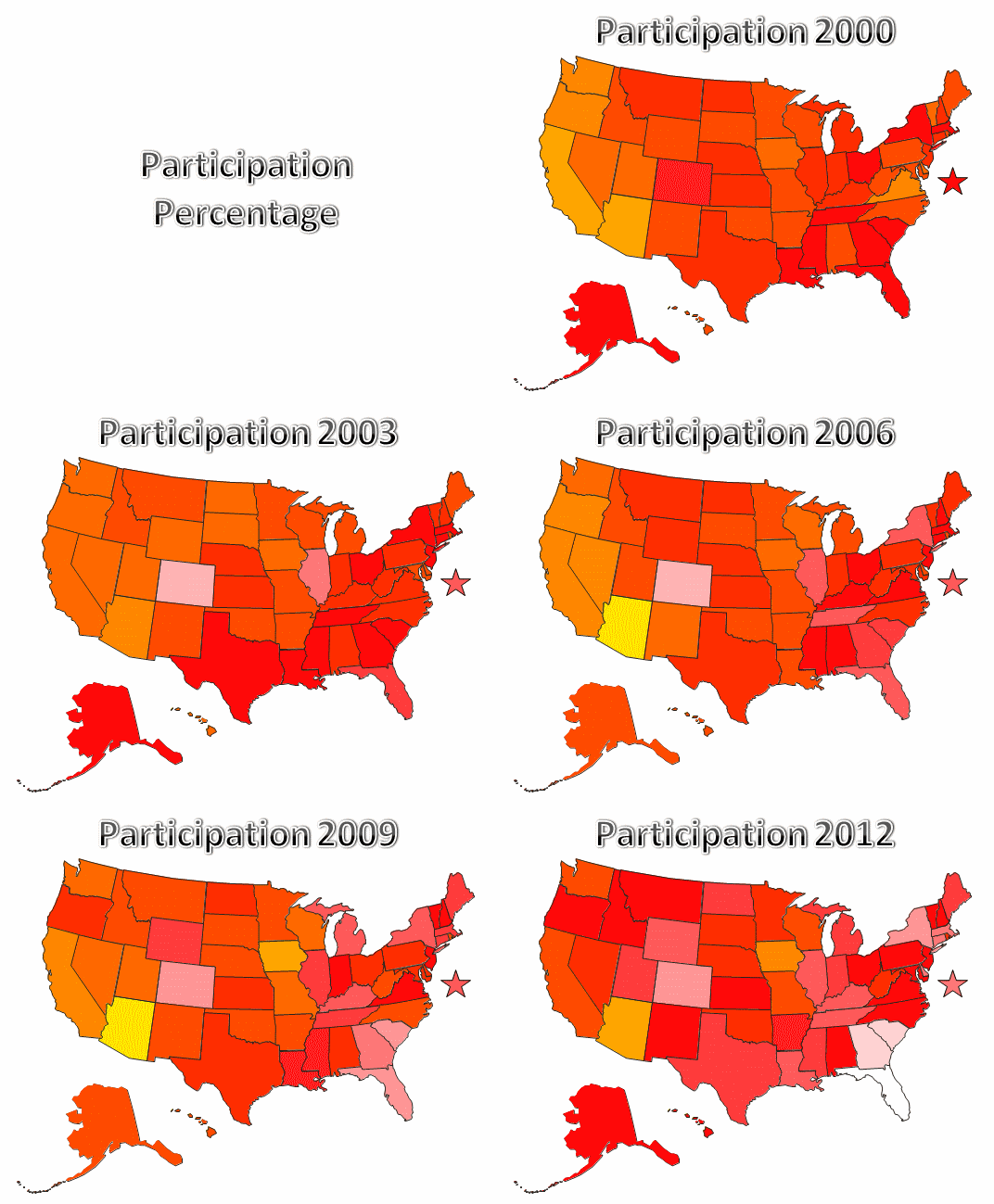
State participation changes confound state scores in multiple ways, but a movement towards full participation on the ACT could settle this issue. States increasingly seem to favor the ACT over the SAT, which I suspect is partly due to the false impression that ACT scores are less racist. Demographic changes correspond to falling test scores, and one can see it, at least in terms of a North-South divide, on these maps. America is bearing a zombie apocalypse, which is sweeping the nation and coming for our brains.
 Duckworth AL, Quinn PD, Lynam DR, Loeber R, & Stouthamer-Loeber M (2011). Role of test motivation in intelligence testing. Proceedings of the National Academy of Sciences of the United States of America, 108 (19), 7716-20 PMID: 21518867


