
nce upon a time, a people now known as African Americans left plantations of slavery to live in relative peace among white people. Unfortunately, the mean, villainous whites schemed systems of organized crime that allowed them to enrich themselves into tranquil opulence, while they excluded the African Americans from their illegal get-rich connivances. Amidst their impoverishment, the African Americans experienced a psychological transformation that forced many of them to become violent criminals. The End.
This story emerges from the works cited by Steven Pinker in his bestselling, and possibly Pulitzer Prize-winning book, The Better Angels of Our Nature. Pinker writes,
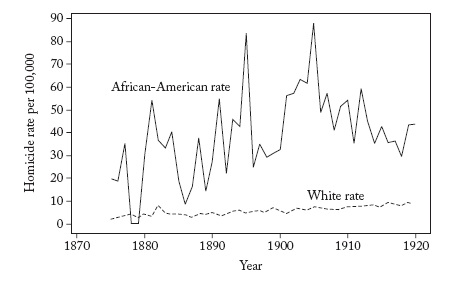
Figure 3-14 shows the rates for two cities in which black-on-black and white-on-white homicides can be distinguished. The graph reveals that the racial disparity in American homicide has not always been with us.
Here is the figure:

He cites Eric Monkkonen’s Murder in New York City, which says,
Essentially, crime was more profitable for whites, whereas even in crime, discrimination blocked the more lucrative opportunities for African Americans and encouraged more violent, destructive offenses.
Pinker’s characterization of homicide data is another example of his distortions on matters pertaining to race and violence. See my
previous post on how Pinker flubbed his summary of the decades of research on the best understood violence gene, including his citation of a copy-and-paste error. Much of his data for New York City in the above graph, including all years of equal homicide rates, comes from American History by Randolph Roth, who plotted a similar graph shown below and made clear that the data plotted actually do not represent known intraracial homicide assailants, but just homicide victims.

In fact, Roth further qualified the data for Philadelphia:
It may prove that blacks accounted for a greater proportion of homicide perpetrators than victims in Philadelphia, but determining that will require more data, including a tally of blacks and whites killed in riots. Blacks committed homicide there at over twice the rate whites did, 1839-1846, according to indictment records (6.5 per 100,000 adults per year versus 2.7), because they were more likely to commit both intraracial and interracial homicide. It may be that Philadelphia’s antiblack riots, the disfranchisement of blacks in Pennsylvania, and increased competition with whites for unskilled jobs were beginning to take their toll.
Roger Lane also questioned Philadelphia’s homicide victimhood data because coroners’ records “proved unreliable.” Coroners frequently failed to indicate that a death was a homicide. Ted Robert Gurr thought this problem might exist in other American cities of that era, but no one had bothered to check as Lane had done in Philadelphia.
Roth did provide actual estimates of New York City homicides, which doubled the very small racial gap in victimization. For Philadelphia, Pinker was not clear whether and for what years he made use of Roth’s data. Roth estimated that, from 1839 to 1846, Philadelphia’s African-American rate of homicide victimization was 28 percent higher than that of whites.
Monkkonen provided some context for the period of purported New York City homicide racial equality. First, he advised caution about the quality of the data. “Even though we can outline this demographic history of black New Yorkers, we cannot yet establish precise population measures… Thus, any construction of rates with at-risk denominators must be understood as estimates.” How unfortunate that this important historic moment of violence equality was so poorly documented.
Generalizing New York City to the rest of America has other complicating factors. Monkkonen offered estimates that suggest that racial homicide equality resulted from enormous white ethnic inequality. “My best estimate for the decade centered on 1860,” he wrote, “sets the Irish homicide rate at 37.5 per 100,000 adult males, the German rate at 15.7, and the black rate at 32.” About half of New York City’s population was immigrant in 1860. It is ironic that Pinker is allowing the violent tendencies of New York Irish-American immigrants to characterize the behavior of American whites in general because English Americans took to calling them “white Negroes.”
Lastly, the age demographics of these groups differed. In 1850, Irish immigrant males in New York City were 19 percent more likely to be in the potentially more violent age range of 16 to 45 than African-American men, and, despite being half as homicidal, German immigrant men were 73 percent more likely than African-American men to be in that age range. Monkkonen does not entirely attribute the eventual growth of a large racial homicide gap to poverty because New York City experienced a massive growth of young black men, such that in 1940 only 19 percent of African-American New York City men in this age range were born there.
Another recently published study, which Pinker did not consider, about this period described a qualitative distinction of racial patterns of violence. Last year, Carlina de la Cova published the first large-scale analysis of its kind, reviewing 651 male cadavers “of low socioeconomic status born between 1825 and 1877” from Cleveland, St. Louis, and Washington DC. Though these remains are apparently not of homicide victims, they do offer evidence of racial differences in violence from that era, but only among the poor, as none owned property, and most were transient. Thus, the study should bias towards exaggerating white delinquency with a sample more unrepresentative of whites than African Americans.
Although fully 92 percent of all cadavers had skeletal fractures, in every category of fracture, whites had more. The smallest differences were for injuries that were most plausibly from serious fights. 50 percent of whites had cranial fractures, compared to 48 percent of African Americans. 44.8 percent of whites had nasal fractures, compared to 42.3 percent of African Americans. Differences for vertebrae fracture rates were much greater, at 72.7 percent for whites and 35.8 percent for African Americans. De la Cova considered osteoporosis as a possible explanation. She noted that African Americans have less osteoporosis, greater bone mass, denser cortical bone, and lower bone resorption. Indeed, black people have greater bone mineral density from infancy, and hormonal levels contribute to such racial differences,
even in childhood,. (Recall that the media accused research oncologist Kathy Albain of
“racial medical profiling” for discovering that racial disparities in cancer mortality remain only in cancers related to sex hormones after accounting for zip code.) Of course, skin color affects the pathways of the hormone vitamin D. De la Cova checked for an influence of osteoporosis and age of death, but that negative result does not negate the fact that black people have stronger bones even in comparisons of whites and blacks without osteoporosis. This seems to extend to tooth loss, which de la Cova also utilized in her attempt to support differing rates of fighting. Even in the present-era
National Health and Nutrition Examination Survey-III, in which whites were better educated, white people still had a higher rate of tooth loss than African Americans and Mexican Americans. In fact, having less education was significantly associated with tooth loss in white people, but not African Americans and Mexican Americans.
Even so, de la Cova points to historical accounts of popular and “ritualized” pugilism among poor white men to settle disputes and protect their “honor,” which logically might play less of a role in the violent behavior of a systematically oppressed minority.
On the other hand, black men comprised all eight of the gunshot wounds, most having a bullet embedded in a bone. Though this was a small number of the cadavers, historical accounts and African-American newspaper advertisements also reflected a gun-oriented African-American culture. Perhaps their early association with guns made fistfights an untenable means of resolving conflicts.
The US Census Bureau did not start tracking crime until 1880, and despite being a minority, African Americans were receiving 54 percent of unlawfully concealed weapons charges and 75 percent of exhibiting a deadly weapon charges and were committing 83 percent of shootings, 85 percent of stabbings, 48 percent of manslaughter homicides, and 43 percent of murders.
Perhaps the best argument for an era of relative homicide equality would be the well-documented, enormous widening of the racial homicide gap in the years that followed. Gurr provided an illustrative graph of this for Washington DC.

Here is Jeffrey Adler’s homicide graph for Chicago when African Americans were a tiny minority of the population.

Societal changes can influence patterns of violence, and these years certainly qualified as profoundly transformative for African Americans. However, given that African Americans have higher allele frequencies than whites of all or (debatably) nearly all identified violence genes, anyone who advertises a distant past of black peaceableness deserves an inspection of their data. I suggest this should even be so for a beloved Harvard celebrity professor.

Adler, Jeffrey S. 2006. First in Violence, Deepest in Dirt: Homicide in Chicago, 1875-1920. Cambridge, Mass.: Harvard University Press.
De La Cova C (2010). Cultural patterns of trauma among 19th-century-born males in cadaver collections. American Anthropologist, 112 (4), 589-606 PMID: 21132946Gurr, T. (1981). Historical Trends in Violent Crime: A Critical Review of the Evidence Crime and Justice, 3 DOI: 10.1086/449082Hui SL, Dimeglio LA, Longcope C, Peacock M, McClintock R, Perkins AJ, & Johnston CC Jr (2003). Difference in bone mass between black and white American children: attributable to body build, sex hormone levels, or bone turnover? The Journal of clinical endocrinology and metabolism, 88 (2), 642-9 PMID: 12574194Jimenez M, Dietrich T, Shih MC, Li Y, & Joshipura KJ (2009). Racial/ethnic variations in associations between socioeconomic factors and tooth loss. Community dentistry and oral epidemiology, 37 (3), 267-75 PMID: 19302573Lane, Roger. 1979. Violent Death in the City: Suicide, Accident, and Murder in Nineteenth-Century Philadelphia. Cambridge, Mass.: Harvard University Press.
Monkkonen, Eric H. 2001. Murder in New York City. Berkeley: University of California Press.
Pinker, Steven. 2011. The Better Angels of Our Nature: Why Violence Has Declined. New York, New York: Viking Penguin.
Roth, Randolph. 2009. American Homicide. Cambridge, Mass.: Harvard University Press.



 Steven Pinker’s new book, “The Better Angels of Our Nature,” is out, and the reception reminds me of an album release from a trendy band during the 1990’s. I must beg my readers’ forgiveness for writing this very preliminary review for a book that I have not finished because the subject matter is so important. Most reviews and buzz for this book center on Pinker’s observations about the decline of violence and the advance of enlightened views. Pinker has been speaking about this phenomenon for years, and many facets of it are apparent in my own lifetime, such as the utter metamorphosis of public consensus regarding homosexuality. The book has a number of fascinating graphs that speak to the changes, and I have little reason to critique his central thesis, other than to say that I am not sure the trend entirely represents genuine progress. For example, I suspect that he could have placed a graph of the decline of fat jokes alongside his graphs of the decline of racial prejudices. While society has improved control over physical aggression, the obesity epidemic proves that indiscipline still finds expression. In fact, when one considers the growing acceptance of “alternative”—excuse me, “integrative” medicine, one can see how the triumph of enlightened tolerance can coincide with a lax shrug off of reason and scientific rigor.


