Showing posts with label Asian. Show all posts

Thursday, December 6, 2012

Inscrutable Voters


Debates about religion fascinate me, and I confess that I have always felt more inclined to the skeptical side. However, I have to respect the sheer cynical self-centeredness of Pascal’s wager. Fortunately, a new and equally pragmatic contention has arisen before my death: Republicans must convert to atheism to win the Asian vote! At least, that is my summation of the reaction to an exit poll from the recent presidential election that revealed strong support for President Obama among Asian Americans. Steve Sailer questioned the validity of this exit poll, but if there is one salient lesson from this election, it would have to be that polls are always right. The concern seems to center on the belief that Republicans swung too far towards the religious right by choosing a Mormon Massachusetts governor. LDS is a strict, conservative denomination, but I implore for imperturbation for two reasons: one, Mormons are a collection of happy-go-lucky genealogy and board-game enthusiasts, and, two, Mormonism might follow the trajectory that I predict for Scientology. When Scientology becomes the largest religion, a sealed envelope will provide L Ron Hubbard’s final testament: “Gotcha! Hope you enjoyed it.” In any case, the facts on the ground hardly matter when the libertarian elite must spin a loss to thwart populists with pitchforks. Who knows? Maybe in fifty years, the Asian vote will grow significant enough to turn this strategy into a comeback.

My first encounter with this strategy was on the site of temperamental science blogger Razib Khan. He did not so much lay out a plan as call everyone retarded for not seeing how obvious it is that Asians moved left as a direct consequence of losing their religion. “It’s not even in the class of a non-obvious prediction. Rather, the description screams at you.” To bolster his argument, he began swearing.

Soon thereafter, author Charles Murray joined in. “Republicans are seen by Asians—as they are by Latinos, blacks, and some large proportion of whites—as the party of Bible-thumping, anti-gay, anti-abortion creationists.” By creationism, he means the absurd, literal interpretation of the Book of Genesis, not the process by which liberals and libertarians create new rights out of nothingness. Murray might have a point. Why could not Governor Romney have paused his gay-bashing for a proper discussion of the issue of, say, taxation policy? Come to think of it, some of my best friends are Asians, and they see the Republican Party as the party of fat-cat, universal-healthcare-bashing global-warming deniers.

So, Murray and I seem to be on the same wavelength, but then I came across a curious statement. “Politically, a college education is a wash—in the General Social Survey, almost identical proportions of college graduates identify themselves as liberals and conservatives.” Razib contends that religious beliefs recently precipitated an attitudinal shift, and Murray describes this Asian political persuasion, while postulating that education played no role. Since Murray co-wrote The Bell Curve, perhaps he has noticed the radical improvement of SAT and ACT scores among Asians that could easily rival other cultural shifts, and since he works for a conservative think tank, perhaps he understands that university culture tends to espouse a certain ideology of its own. Though Asians are so much the Other that social scientists still label them “other race,” as the General Social Survey (GSS) does, Asians nevertheless adapt well. Confucius said, “Speak with sincerity and honesty, be humble and respectful, and you will get along even if you live among the barbarians.” Chinese people are the Asian prototype of nice folks who blend with the scenery. They adopt Islamic last names in Muslim nations and Christian first names in the lands of the West. Some Asians fled Communism, as Murray noted, but the Chinese diaspora was considered a bastion of Marxist agitation just a generation ago in pre-independence Singapore. How hard is it to imagine that some Asians adapt to the university ideology? In addition, I have noted previously that high intellect is more associated with liberal values and that the SAT is an IQ test, though not by design.


Murray is mostly correct about political ideology and education. This scale of conservativism is from one to seven with four being “moderate” and one being “extremely liberal.” Only those with graduate degrees are much more liberal than people with other education levels. However, for education to be “a wash” for Republicans, should not party identification receive the attention?


Education is not “a wash,” but it appears to be the opposite of my expectations. The scale extends from zero to six with three being “independent” and zero being “strong Democrat.” Republicans sensibly educate themselves to the level of a bachelor’s degree, before seeking out the upper-middle class and a house in the suburbs. Benighted high school dropouts are more conservative than they are Republican probably because the uglier aspects of conservativism that Murray so detests define their values. Indeed, high school dropouts are the least likely to agree that humans evolved from prior species.

Now to the premise, have Asians changed their political views? Since the GSS had not been using Asian as a race in its primary race survey question, I have graphed each Asian ethnic category. For conservativism, the main trend appears to be a reduction of statistical noise as the sample size increased. Filipino-Americans had the largest sample, followed by Chinese-Americans. Japanese-Americans, with the least, had about half as many respondents as the Filipinos and Chinese. Therefore, perhaps the uptick of Chinese-American Republicanism since 2008 is a real shift to the right. The conservativism trend for this group does echo party affiliation.


The evidence for an Asian political shift in the GSS is either not there or perhaps starting towards the political right, at least for the Chinese. The survey’s most recent results were 2010, but if Khan is right about religious beliefs playing the dominant role of influencing votes or if my hypothesis was right that the academic or intellectual progress was having an effect, I would have expected many years demonstrating a political shift, barring inadequacies of the survey. Surely, the study acknowledges that Asians have advanced in their educational accomplishments.


Yes, it does. The GSS also contains Wordsum, a ten-word vocabulary test that has some correlation with intelligence. Given the very clear evidence of improvement for Asian Americans on both the SAT and the ACT, as well as the improved education levels, one would expect a positive trend for Wordsum, too.


Unfortunately, these scores show no such evidence. Any number of explanations could address the discrepancy, while allowing for one’s personal biases to enter the equation. Those with contempt for Asians could find fault with the college entrance exams or explain away SAT scores as soulless cramming endeavors. Asian defenders can point out that the GSS has a small Asian sample size of about a thousand cumulatively over 38 years rather than the SAT’s tens of thousands each year, that a short vocabulary test does not represent general intelligence as well, or that a high proportion of Asians are not native-English speakers. The scores appear unbelievably low for Asians. For instance, in 2010 the average Indian American had a lower Wordsum score than the average African American. Indian Americans have the highest household annual income of any Asian-American ethnic group at over $90,000, which is more than twice that of the average African-American family.
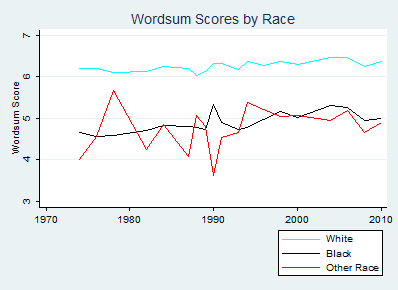

An ongoing debate in America concerns whether Hispanic people are a race or are mostly members of the white race, having Hispanic ethnicity. Since they are the largest minority, they might account for the bulk of those in the graph delineated as “other race,” whose scores seem flat and at about the level of African Americans. Ron Unz recently asserted that the GSS shows dramatic score improvement for Mexican Americans. Apparently, the blog, Inductivist, first noticed this.


Here we see Ron Unz’s “super-Flynn effect,” through which “ the Mexican-American Wordsum-IQ increased from 84.4 in the 1980s to 95.1 in the 2000s, while the rise for American whites was from 99.2 to 101.3.” Wait! I see that just prior to the super-Flynn effect an even larger super-dimming effect from 1976 to 1982 deflated Mexican-American scores in many fewer years. Likewise, Puerto Ricans’ Wordsum average fell from over five to under three in only two years! Come to think of it, Japanese Wordsum average rose six points from 1990 to 1991, (which I attribute to the release of the Violator album by Depeche Mode). The GSS sample is 4.1% Mexican-American. Mexican Americans are 10.5% of the US population. So, one can imagine that earlier decades of survey samples had small numbers for this group, which would explain the noise in the graph. This teaches the valuable lesson that graphs reveal truths better than carefully selected numbers.

If the Asian sample is not large or representative enough to properly detect shifts of voting behavior, improved intellect, or even a ballpark range of Asian intellectual abilities, I can muster little confidence in any information that I can glean for this group. However, I decided to create more detailed graphs of each Asian ethnic group for political views, Wordsum scores, and educational attainment to look for patterns. Most had none.


Despite the apparent recent trend toward conservative politics, Chinese people do not appear to have clear links between politics, education, and scores. On the political-ideology graph, notice the unwillingness of Chinese people to be extremely anything.


For Indian Americans, I do see a consistent pattern that the most educated and intelligent have recently started becoming more conservative and Republican. Consistency between graphs does not discount issues with sample size, but the recent years for Indian Americans with graduate degrees look smoother, which could reflect an increasing sample thanks to the H1B visa program. Contrast that with the noise in a graph for Japanese people.


Coulter’s Fallacy


Using Wordsum, the GSS can check the purported relationship between liberal political views and intelligence. For political ideology, the relationship presents itself. However, party affiliation appears different.


These graphs do not control for any confounding variables, and race is an obvious potential confounder. However, the associations also appear when the graphs are limited to white people, except for strong party identification in recent years.


Republicans tend to be smarter than Democrats, but liberals tend to be smarter than conservatives. Republican strategists should take note of the obvious strategy to appeal to the stupid vote. Maybe they already have. On the contrary, the party has been focusing on reaching out to minority voters, and the following graphs give some indication of the results:


The graphs are distorted by the designation of “other race” as being worth three points, whereas African Americans are worth two points. (At least it is not three-fifths.)

Minorities should be joining the GOP by the boatload, considering effusive praise like this from author Ann Coulter:
That’s why our blacks are so much better than their blacks. To become a black Republican, you don’t just roll into it. You’re not going with the flow. You have fought against probably your family members, probably your neighbors. You have thought everything out, and that’s why we have very impressive blacks in our party.
According to the GSS, their blacks are actually better than her blacks. Perhaps that is changing for those who are the strongest Republicans, but the sample size for that group is likely to be very, very small.


What Republicans really hunger for is the Hispanic vote, so I present this very important graph about Mexican Americans:


At first, a pattern might not jump out, but if one stares long enough, everything makes sense. Then, if one closes one’s eyes, a photo negative of the graph will appear.

Republicans commit a basic error when envisioning Hispanic Americans or African Americans as “natural conservatives” in that they conflate conservativism and Republicanism. Minorities tend to identify with conservativism much more than the Republican Party.


For some, the vagueness or emptiness of the term conservative might allow for posturing about values or lifestyle. Still others actually embody the vulgar close-minded thinking and parochialism that puts off Murray. It helps to consider how some socially conservative beliefs are natural reactions to some unhealthy societal changes, and values that sustain a family contrast with the blandness of haggling over the budgetary pie for already well-off interests. Confucianism serves as a fine example of an Asian social philosophy that contrasts with the libertarian, Randian individualism. Murray is right to defend science and reason, but the best strategy to win the votes of Asians and others is an intelligent populism.

Sunday, October 9, 2011

Girls Versus Boys: The Final Battle

submit to reddit

SAT data provide an exciting reservoir of information thanks to extremely large sample sizes with detailed demographic data over a number of years. I previously graphed SAT scores by race and showed that the score gap between White people and African Americans greatly narrowed until the early 1990’s and that Asian Americans have been improving their SAT scores, unlike other groups. Now, I shall present how men and women compare for each racial group.


In 1966, William Petersen coined the phrase “model minority” to recognize the accomplishments of Japanese Americans. Liberals revised the label to “model minority myth,” which imparts elements of bitter sneering and jealousy, but the original compliment has never been truer for the SAT results of Asian Americans. Asian-American women appear to be advancing even faster than their male counterparts. Recent years have brought declines in the standard deviation gaps between Asian-American men and women on the math and critical reading (formerly “verbal”) sub-tests.

May all the trees that died for treatises on the eroticization of Asian women and the emasculation of Asian men rest in peace. With that said, I shall add my Asian Female Fit Hypothesis: Asian women are able to progress faster than other demographic categories because they transcend gender roles and expectations, in contrast with White women.

Though White women did slightly improve last year on the math SAT sub-test relative to White men, that was mostly due to a slight drop in the male score. Numerous factors could be discouraging academic progress for White women, particularly in math and the hard sciences. White women, as a group, might not place as high a priority on accomplishment in mathematics. Perhaps they see math as leading to career tracks that are less enjoyable or that would earn an income that would intimidate male suitors. Perhaps they associate math with demanding but financially rewarding careers, and some of them feel that only men should have to fill such a demanding provider role. Advanced math coursework and preparation could have a culture that is unappealing to White women. Also, a common view argues that women feel displaying intelligence makes them less attractive to men. For both young men and women, distractions can hurt academic performance, but perhaps White women are more preoccupied by them than White men.

I suggest that Asian-American women are able to transcend such barriers better than White women. Asians, in general, have a higher average IQ and tend to perform especially well on the SAT math sub-test. This advantage could give Asian women a confidence with mathematics above some threshold that makes further study more enjoyable and less intimidating. Another commonly held view is that Asian women are more amenable, perhaps owing to Confucian values, to relationships with studious men with whom they would come more in contact. I think that men actually do appreciate intelligent women, and the cultures of professions steeped in mathematics, like engineering, are so lacking in female representation that Asian women on such professional paths might be finding a comfortable niche. I also propose that Asian women have the advantage of simple beauty.

At first, one might think that physical attractiveness has nothing to do with mathematics skill, but beauty and fashion have a profound effect on the self-esteem of young women and can become a demanding preoccupation. Many Asian women have a simple beauty that does not really require makeup or hair treatments in modern American culture. Most Asian women whom I have known also seem to be naturally thin without exercising. A recent large meta-analysis of genome-wide association studies found three important loci for body fat percentage. According to the HapMap database, two of the alleles associated with increased body fat are far more common in White and Black people than in Chinese and Japanese people. The third allele is somewhat more common in Japanese and Chinese people, but the study found that this allele was associated with body fat percentage in Europeans, not in people from Northern India.

Allele Frequencies of loci that increase body fat percentage:

FTO:
White – 46.0%
Chinese – 13.9%
Japanese – 18.6%
African-American – 46.5%
Nigerian Yoruban – 45.2%
Mexican-American – 20.7%
Gujarati Indian – 25.2%

IRS1:
White – 41.8%
Chinese – 10.0%
Japanese – 6.8%
Nigerian Yoruban – 64.3%

SPRY2 (increased body fat percentage in Europeans, not Northern Indians):
White – 27.7%
Chinese – 48.1%
Japanese – 45.0%
African-American – 14.0%
Nigerian Yoruban – 18.4%
Mexican-American – 35.3%
Gujarati Indian – 48.5%

African-American women also are closing their gap with African-American men on the SAT math sub-test, but scores for Black people, as a whole, are declining, and the gap with White people seems to be slightly widening, as I previously discussed. Still, African-American women are the only demographic to consistently outperform their male counterparts on the SAT critical reading sub-test. On the newer writing sub-test, all demographics have a female advantage, but African Americans have the largest gender gap, and it is growing. Ever since the writing sub-test began in 2006, African-American women have had a consistent total raw score advantage over African-American men, and they are the only group of women to ever do so. Although it might be declining, the Hispanic male advantage over Hispanic women lies at the other end of the spectrum.


In conclusion, whether you are a dumb blonde, a dragon lady who is good at math, a troubled Black man, or a macho Mexican, the SAT reinforces the offensive stereotype that is right for you.

ResearchBlogging.org


Kilpeläinen TO, Zillikens MC, Stančákova A, Finucane FM, Ried JS, Langenberg C, Zhang W, Beckmann JS, Luan J, Vandenput L, Styrkarsdottir U, Zhou Y, Smith AV, Zhao JH, Amin N, Vedantam S, Shin SY, Haritunians T, Fu M, Feitosa MF, Kumari M, Halldorsson BV, Tikkanen E, Mangino M, Hayward C, Song C, Arnold AM, Aulchenko YS, Oostra BA, Campbell H, Cupples LA, Davis KE, Döring A, Eiriksdottir G, Estrada K, Fernández-Real JM, Garcia M, Gieger C, Glazer NL, Guiducci C, Hofman A, Humphries SE, Isomaa B, Jacobs LC, Jula A, Karasik D, Karlsson MK, Khaw KT, Kim LJ, Kivimäki M, Klopp N, Kühnel B, Kuusisto J, Liu Y, Ljunggren O, Lorentzon M, Luben RN, McKnight B, Mellström D, Mitchell BD, Mooser V, Moreno JM, Männistö S, O'Connell JR, Pascoe L, Peltonen L, Peral B, Perola M, Psaty BM, Salomaa V, Savage DB, Semple RK, Skaric-Juric T, Sigurdsson G, Song KS, Spector TD, Syvänen AC, Talmud PJ, Thorleifsson G, Thorsteinsdottir U, Uitterlinden AG, van Duijn CM, Vidal-Puig A, Wild SH, Wright AF, Clegg DJ, Schadt E, Wilson JF, Rudan I, Ripatti S, Borecki IB, Shuldiner AR, Ingelsson E, Jansson JO, Kaplan RC, Gudnason V, Harris TB, Groop L, Kiel DP, Rivadeneira F, Walker M, Barroso I, Vollenweider P, Waeber G, Chambers JC, Kooner JS, Soranzo N, Hirschhorn JN, Stefansson K, Wichmann HE, Ohlsson C, O'Rahilly S, Wareham NJ, Speliotes EK, Fox CS, Laakso M, & Loos RJ (2011). Genetic variation near IRS1 associates with reduced adiposity and an impaired metabolic profile. Nature genetics, 43 (8), 753-60 PMID: 21706003

Sunday, September 18, 2011

Intelligence

This page will serve as a permanent index of all of my writings on intelligence and psychometrics.

The Post-Racial Era is Over – January 8, 2010

Smart People are Educated, Greedy, Sexist Bigots – July 20, 2011

Meet Towelie, the IQ Test of the Future – August 27, 2011

The SAT’s Cohen’s d & the Topography of IQ Denialism – September 2, 2011

The SAT in Red, White, and Brown – September 18, 2011

Girls Versus Boys: The Final Battle – October 9, 2011

Racial Amplitudes of Scholastic Aptitude – April 11, 2012

The SAT Bell Curve – April 25, 2012

Just Say No Limit: Trayvon, Dextromethorphan, Marijuana, and MAOA – July 5, 2012

The Hispanic Asian Flynn Effect – August 5, 2012

Genes Dealt Made Asians Svelte – September 10, 2012

The SAT Zombie Apocalypse – September 29, 2012

Arthur Jensen & JP Rushton – November 1, 2012

Inscrutable Voters – December 6, 2012

Scientists Rediscover the Violence Gene, MAOA-2R – December 30, 2012

The SAT-ACT Score Map – June 10, 2013

Black Suits, Gowns, & Skin: SAT Scores by Income, Education, & Race – October 24, 2013

Parents’ Income Poorly Predicts SAT Score – July 4, 2014

Merit’s Liquidity – October 18, 2014

The SAT in Red, White, and Brown

submit to reddit
The College Board just released another year’s set of SAT results, and Steve Sailer’s blog took notice of the results and the posts that I have recently made on the subject. I try to emphasize science over conjectured analysis on this blog so that my readers can feel some confidence in the knowledge they gain here. Interpreting the SAT is complicated by many factors, including the various tweaks and reforms that the College Board has instituted and the changes in the examinee populations. However, using standard deviations should help in making group comparisons because the students are experiencing the same changes. I have tried to address the differences in demographic groups’ increased participation. In general, every group is increasing their participation more than White people. Here is a graph of each group’s increased participation from the year prior:


When one sees the raw-score graphs below, the trend of Asian advancement is obvious, which exposed the anxieties of many White people in the discussions that I saw. Analysis of the data ultimately becomes a Rorschach test of disposition towards Asian cultures. Clearly, SAT scores are revealing strengths that will serve Asians well wherever meritocracy is allowed. A common reaction from some White people to this data is to try to introduce nuance and critical analysis to emphasize flaws in Eastern societies. I think it is reasonable to conclude that every culture has its flaws, which is a strong argument for cultural exchange. However, I believe that those who are trying to champion these arguments just want to explain away Asian accomplishments to convince Whites that they are superior or at least have enough good points to raise the stock value of racial separation. I have yet to see anyone address the fact that such illustrations could have universal appeal. How does one convince the world that a group of people, like White people, is a nice group without also convincing them that the group is also a nice group to be around? Apparently, White nationalists are trying to posture that every group is nice, but only when each is separate, and mixed groups do not count. I think I can make a stronger case that the success of Asians on the SAT proves that testing is not White-supremacist. In fact, as tuition rates grow, tests are less elitist than education and, therefore, more indicative of important characteristics other than privilege.


Here is the updated graph of the Asian-White score gaps in standard deviations.


Here is the updated graph for the Black-White score gaps.


I have not given much discussion on this blog to people who self-identify as having Hispanic ethnicity or those of Native-American ancestry. I think these can be confusing designations for my purposes because I am interested in genetic research, and such groups have significant ancestral overlap, just as many American White people can claim a fraction of Native-American heritage. I find that these minority groups do not receive as much attention in the scientific literature, probably partly for this reason. Native American SAT scores are based on a relatively small and fluctuating sample size, so I caution against drawing strong conclusions from this graph.


I compiled the three Hispanic groups that the SAT delineates into a single population. The Hispanic sample has grown significantly, so an increasing gap might not surprise. However, I would have expected more changes to the verbal/critical reading score gap, either improvement from acculturation and language mastery or a worsening gap from continued immigration of young non-native speakers. Instead, the math score gap has changed more and seems to have converged with the verbal score gap. I could hypothesize that changes made to the SAT caused it to become a more g-loaded exam like an IQ test because general intelligence is a component of both exam sub-tests. This is a hypothesis that could be tested by re-assembling an older version of the test.


However, the Educational Testing Service’s principal measurement statistician Neil Dorans claimed that the 1995 recentering of the test explains this. “[O]n the original [SAT mathematical] scale, scores below 400 were compressed and scores between 400 and 700 were stretched out…. Hispanic students are 40 points higher at the median on SAT M than on SAT V on the original scale, whereas they have the same median (945) for both SAT M and SAT V on the recentered scale. Thus, the major effect of recentering for Hispanic students was to bring SAT V scores in line with SAT M scores and place both sets of scores closer to the midpoint of the score reporting scale.” He also credited recentering with bringing Asian-American SAT verbal scores “more in line with” SAT math scores. However, recentering was supposed to make each group “appear closer to average on SAT M than they appeared on the original scale,” making Asians, Whites, and men “appear less above average” and do the reverse for Black people, Hispanics, and women, without changing the “rank orderings of individuals.” I wonder if this is why the College Board does not make reports from before the recentering available to the general public. If one ignores the raw score graphs and examines the standard deviation numbers compared to White examinees that are published for Black examinees back to 1986 and for Hispanics back to 1992, one can see that the gaps between Whites and these minorities grew. Perhaps an increased sense of competitive urgency motivated White examinees more after 1995.

Any questions one might still have can be answered with a shrug. Dorans insisted we heed a heedless take on the SAT. “To believe that one set of scales represents ‘truth’ is to reify the score scales in a way that scores on general intelligence tests were reified during the first half of the twentieth century.” Then, he provided a reference to The Mismeasure of Man by Stephen Jay Gould.